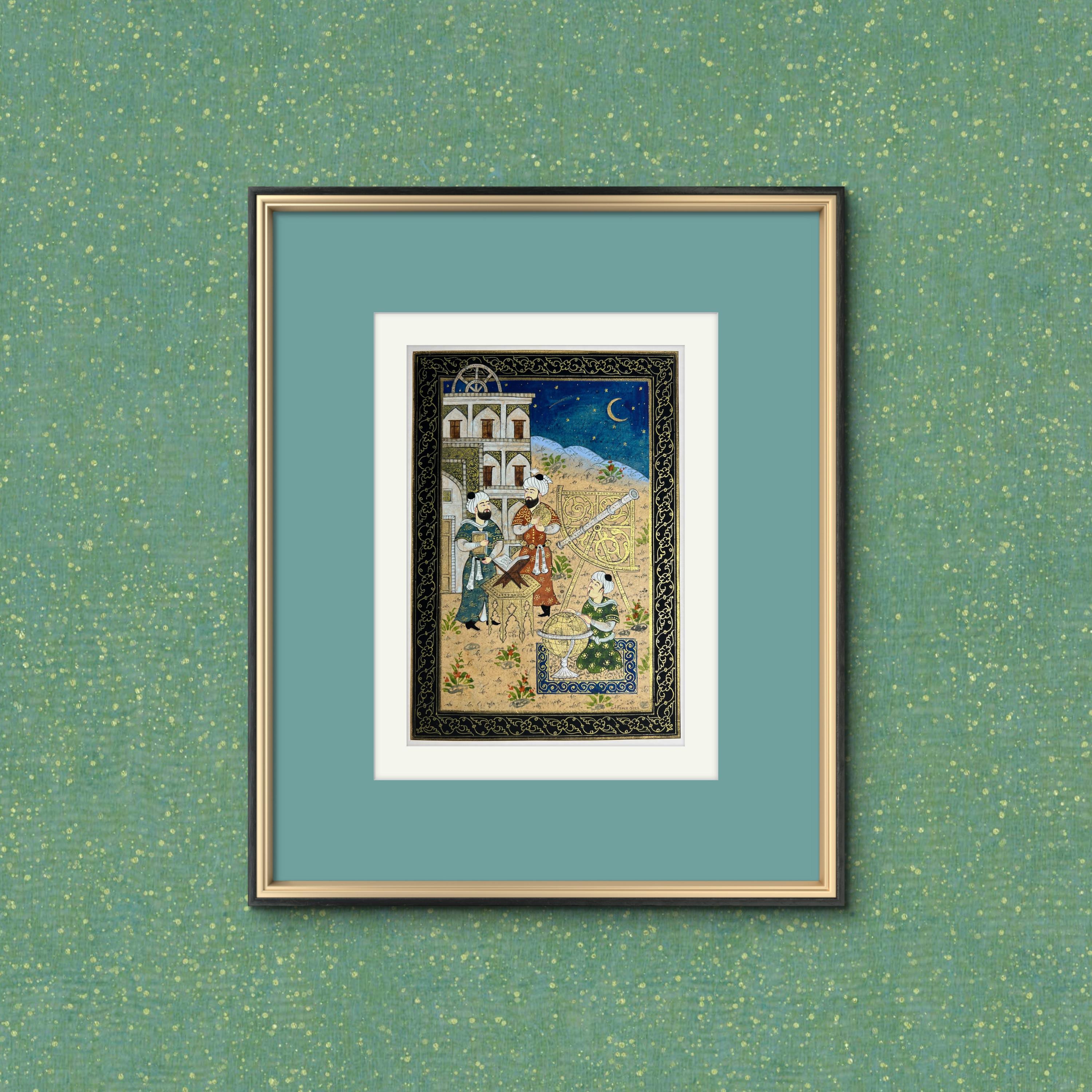
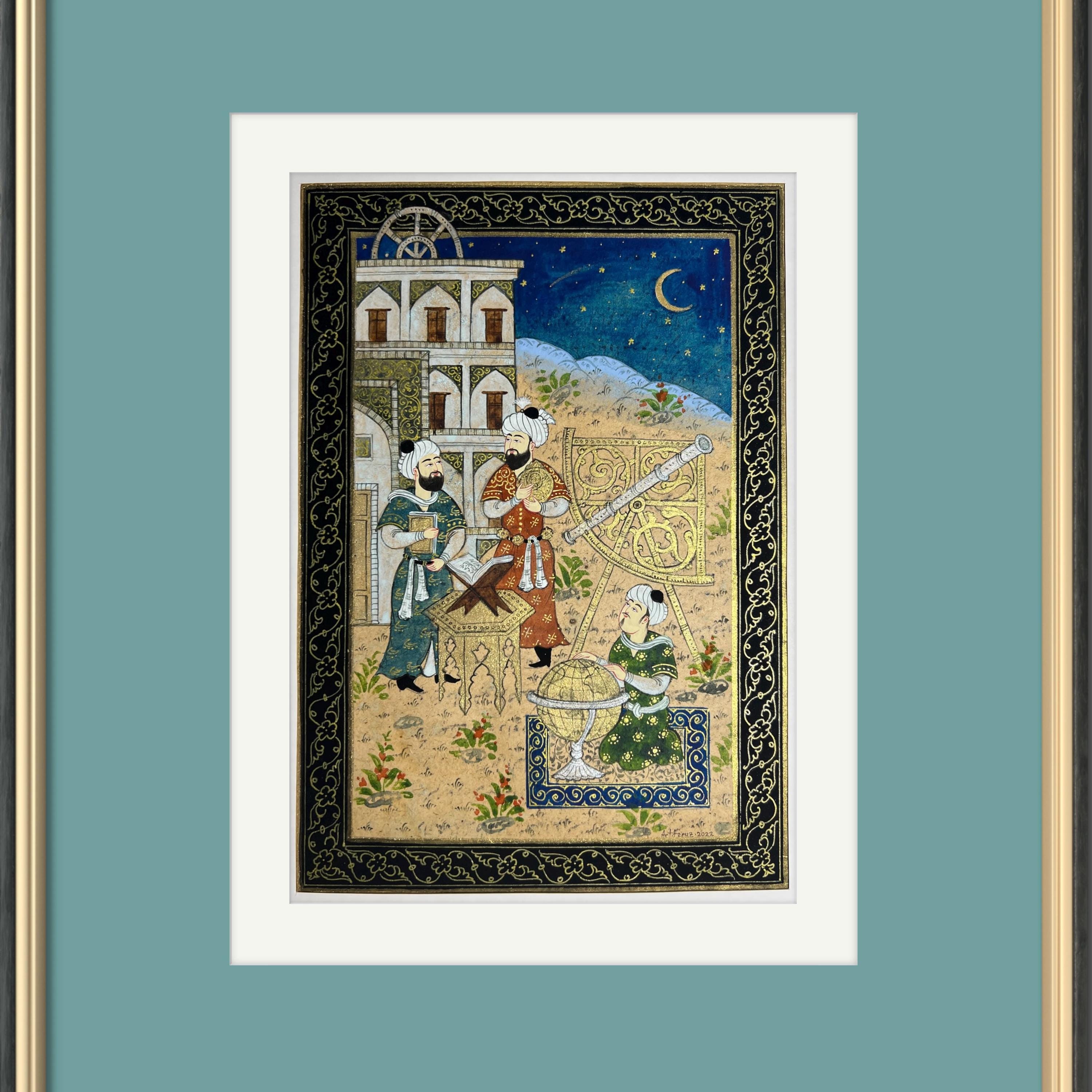
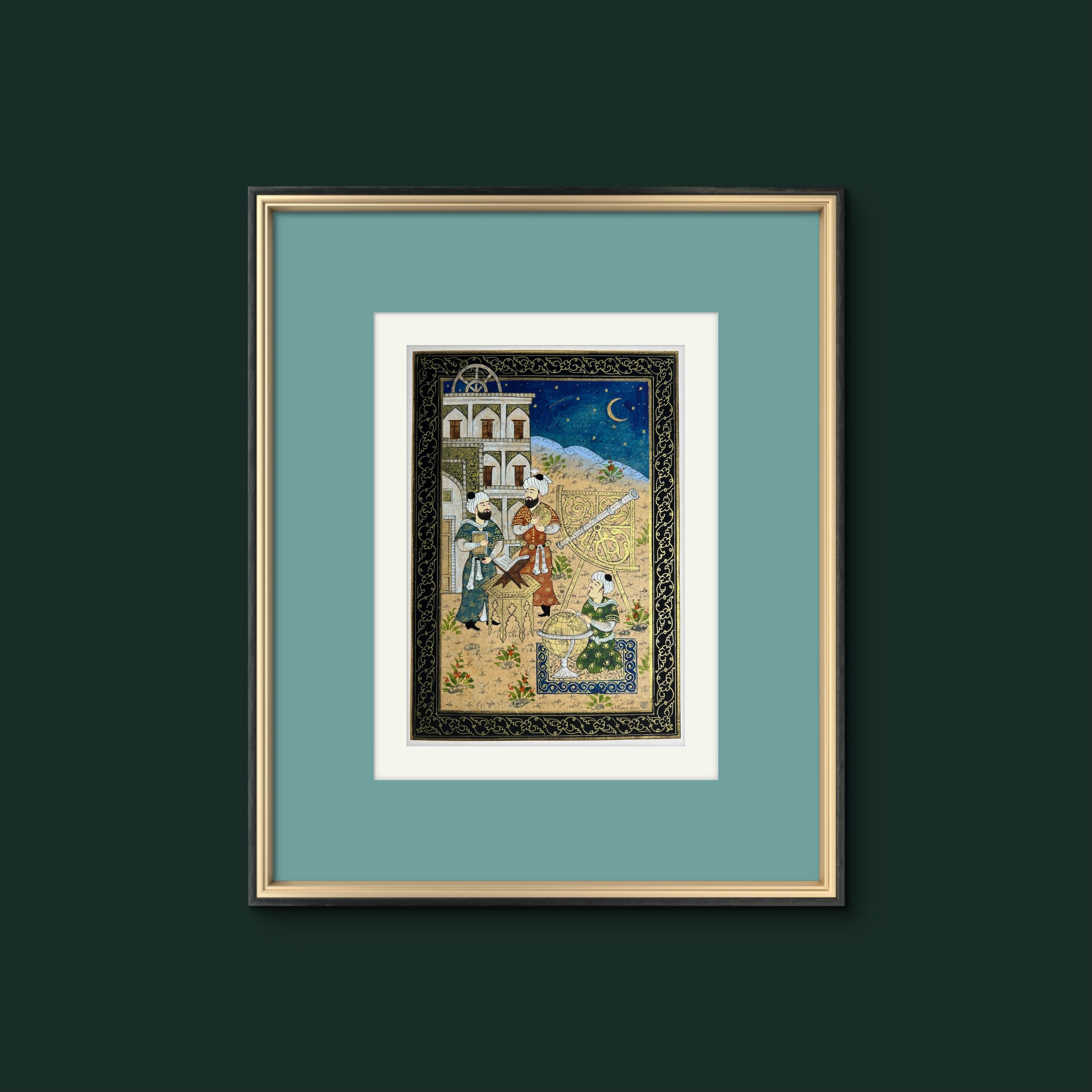


Art Fine Art Miniature painting Acrylic painting Fine brush work Watercolor Ornamental painting
$235.00
Details
We gladly accept custom orders for adjustments in color and size, ensuring that the piece perfectly aligns with your unique vision and complements any space.
Art Fine Art Miniature painting Acrylic painting Fine brush work Watercolor Ornamental painting Central Asian Bukhara UZBEKISTAN.
Ulugbek in his Observatory with his students “ Mirzo Ulugbek “ Astronomer Ulugbek, also known as Mirza Ulugbek, was a remarkable figure in the field of astronomy during the Timurid period. Born in 1394 in the city of Samarkand, Ulugbek was the grandson of the famous conqueror Timur (Tamerlane).
Mirza Ulugbek, commonly known as Ulugbek, was a Timurid prince who ruled over the city of Samarkand in present-day Uzbekistan from 1409 to 1449. While Ulugbek was a skilled military leader and a capable ruler, his true passion lay in the realm of astronomy and scientific pursuits.
Under Ulugbek's patronage, Samarkand became a vibrant center of learning and scholarship. He gathered a team of talented astronomers and mathematicians, including scholars such as Qadi Zada al-Rumi and Ali Kushchi, to work alongside him in his pursuit of scientific knowledge.
The centerpiece of Ulugbek's scientific endeavors was the construction of the Ulugbek Observatory in Samarkand. Completed in 1428, the observatory was a marvel of its time, featuring a massive quadrant and precise instruments for observing the celestial bodies. Ulugbek's observatory was renowned for its accuracy and advanced methods of measurement.
One of Ulugbek's most notable achievements was the creation of the "Ulugbek Catalog." This star catalog recorded the positions and magnitudes of over a thousand stars, as well as the locations of planets and other celestial objects. Ulugbek's observations were remarkably accurate, with his measurements surpassing the knowledge of his contemporaries and rivaling the works of renowned astronomers of ancient times.
In addition to his astronomical pursuits, Ulugbek also made significant contributions to mathematics and trigonometry. His treatise, known as the "Zij-i-Sultani," covered various mathematical topics, including spherical trigonometry, the computation of eclipses, and the length of the solar year. Ulugbek's work greatly influenced the development of mathematical sciences in the Islamic world.
Ulugbek's reign and patronage of the sciences marked a golden age of intellectual and cultural flourishing in Samarkand. Scholars and scientists from different parts of the world were drawn to his court, where they engaged in intellectual discourse and made groundbreaking discoveries.
Tragically, Ulugbek's scientific pursuits and patronage eventually drew the ire of conservative religious authorities who regarded his interests as heretical. In 1449, he was assassinated on the orders of his own son, Abdul Latif, bringing an untimely end to the reign of this visionary ruler and astronomer.
Despite the challenges and the brevity of his rule, Ulugbek's contributions to astronomy, mathematics, and intellectual progress have left an enduring legacy. His observatory and scientific achievements continue to be revered, and his name is associated with a spirit of scientific curiosity and intellectual inquiry in the history of Central Asia.